













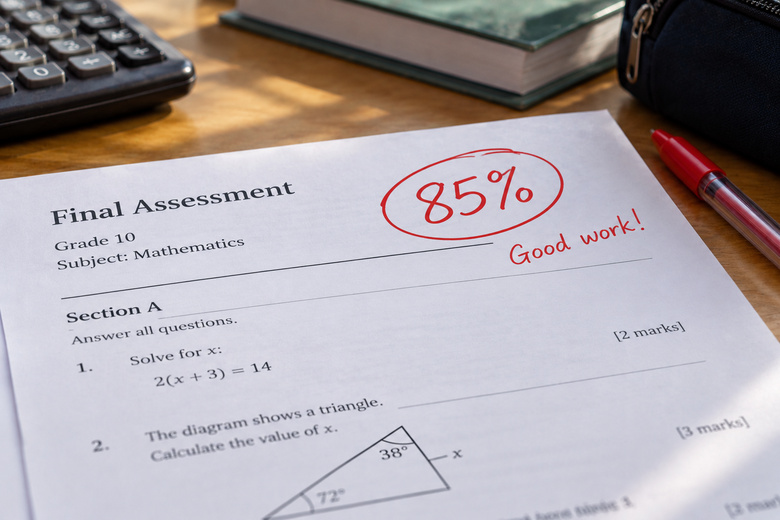
The school grading system in Jeddah gives parents a quick way to track academic progress, but a percentage alone cannot explain everything a child has learnt. Understanding how grades work, what they reveal and where they fall short can help families support their children more effectively.
As Saudi Arabia continues to prioritise educational quality under Vision 2030, the focus extends beyond test results to stronger learning outcomes and the development of essential skills. For parents and educators, this raises an important question. How can schools measure achievement while helping students understand, improve and grow?
How The School Grading System Helps Students And Parents
Percentage grades offer a straightforward way to communicate academic performance. A score of 85% or 92%, for example, gives families an immediate indication of how a student performed in an assessment.
Additionally, a consistent numerical scale can make it easier to compare results across subjects and track progress over time. Teachers can identify areas where students may need further support, while parents can follow their children’s performance and discuss concerns with the school.
Grades can also help students prepare for later stages of education, where academic results often influence progression and university opportunities. Learning to interpret results can encourage students to take greater responsibility for their studies.
However, a percentage is most useful when it comes with an explanation. A high score may show strong performance in a particular test, but it does not necessarily demonstrate that a student can apply the same knowledge in unfamiliar situations.
Why Percentage Grades Do Not Tell The Whole Story
One limitation of percentage grading is that it can encourage students to focus on the final number rather than the learning behind it.
When high marks become the main measure of success, some students may prioritise memorising information for an examination instead of developing a deeper understanding. As a result, they may struggle to apply what they have learnt beyond the test.
There is also the question of academic pressure. Students may feel they must achieve exceptionally high marks to meet family expectations or keep pace with classmates. Parents can experience similar pressure when comparing results between children.
Another concern is grade inflation, which occurs when marks become higher than a student’s actual level of achievement would justify. If grades do not accurately reflect understanding, students may not receive the support they need to improve.
For educators, the challenge is to use grades as evidence of progress rather than as the sole measure of a student’s ability.
Why The Same Grade Can Mean Different Things
Consider two students who both receive 75% in a social studies test.
One student may have misunderstood a central concept and answered every question about it incorrectly. The other may understand the main ideas but have lost marks through several small mistakes.
Although their final scores are identical, their learning needs are different. The first student may need help revisiting a topic, while the second may benefit from practising exam techniques and checking answers more carefully.
This is why feedback matters. A score tells students how they performed, but constructive feedback helps them understand what to do next.
For parents, this distinction is particularly important when reviewing school reports. Rather than focusing only on whether a mark has risen or fallen, families can ask which skills have improved and where further support would make a difference.
What Better Assessment Could Look Like In Saudi Schools
A more complete approach combines percentage grades with other methods of assessment. This is consistent with Saudi Arabia’s wider emphasis on improving learning outcomes and using evidence to identify students’ needs.
The Ministry of Education describes school evaluation as a process of identifying strengths and opportunities for improvement, with the aim of supporting more effective and sustainable development. Official Ministry of Education guidance.
Several approaches can help schools build a clearer picture of student progress.
Clear Assessment Rubrics
Rubrics explain the criteria used to assess an assignment, presentation or project. They help students understand what good work looks like before they begin.
For example, a writing rubric might assess the quality of ideas, organisation, evidence and spelling. Students can then see which areas need attention instead of receiving only a final mark.
Constructive Teacher Feedback
Teacher comments can explain why a student achieved a particular result and how they can improve.
This type of feedback recognises a student’s strengths while identifying a practical next step. It also gives parents clearer guidance on how to support learning at home.
Student Portfolios
A portfolio brings together a student’s work over time, including writing, projects and other assignments. It allows students and teachers to review progress across a term or academic year.
Unlike a single test result, a portfolio can show how a student’s skills develop through practice, feedback and revision. It can also help students recognise their achievements and take greater ownership of their learning.
How Parents Can Use Grades More Effectively
Parents do not need to disregard grades to take a broader view of academic progress. Instead, they can use results as a starting point for conversations with their children and teachers.
When reviewing a school report consider asking,
- Which subjects or skills has my child improved in?
- What do lower marks tell us about areas that need more support?
- Does my child understand the material, or are they mainly memorising answers?
- What feedback has the teacher provided, and how can we act on it?
- What realistic goals should we set before the next assessment?
Meanwhile, families can encourage children to treat mistakes as opportunities to learn. This helps shift the conversation away from marks alone and towards effort, understanding and improvement.
Schools can support this approach by explaining assessment criteria clearly, providing useful feedback and communicating with parents about individual learning needs.
Making School Grading More Meaningful In Jeddah
The school grading system in Jeddah can play an important role in tracking academic performance. However, its value depends on how schools, students and families use the information it provides.
Percentage grades offer clarity and make progress easier to monitor. Yet they work best alongside feedback, clear assessment criteria and opportunities for students to demonstrate what they understand.
Ultimately, educational success is about more than achieving a particular number. When parents and teachers look beyond marks, they can better identify learning needs, celebrate genuine progress and help students develop the confidence and skills to succeed.
For more details please visit
Further Reading
- Abu Dhabi Targets 2,000 Emirati Teachers With New Private School Policy
- What Parents Should Look For In Saudi International Schools