










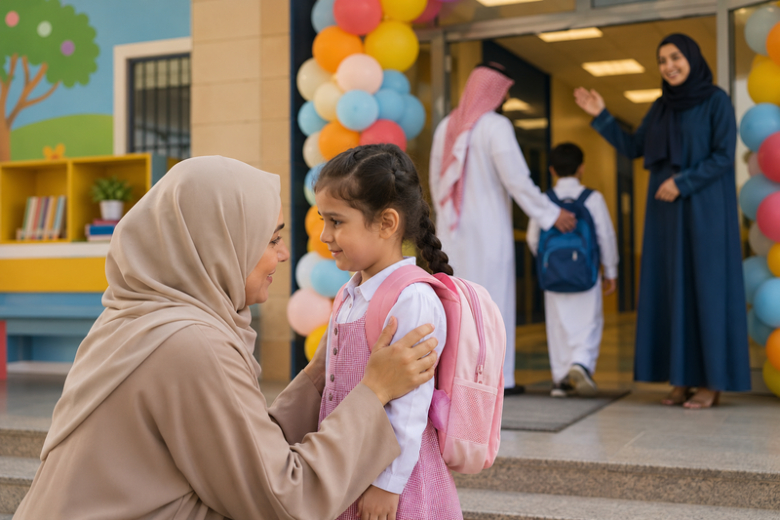
As the Saudi school year begins, the Saudi school transition can bring excitement, uncertainty and anxiety for young children. For first-grade pupils especially, the move into formal schooling is a major change.
Across the Kingdom, schools often mark the occasion with colourful classrooms, balloons, gifts, music and activities. These celebrations can help create a welcoming atmosphere. However, educators and child mental health experts say emotional readiness should remain at the centre of the first week.
For a child holding tightly to a parent and struggling to enter the school gates, a busy celebration may not make the transition easier. Instead, children may need calm reassurance, familiar routines and adults who recognise that anxiety is a normal response to change.
The Ministry of Education designs introductory programmes to help first-grade pupils gradually become familiar with school. These programmes aim to build positive attitudes towards school life and reduce separation anxiety.
However, experts stress that children do not all adjust at the same pace.
Why The First Week Can Feel Overwhelming
Starting school involves several changes at once. Children enter an unfamiliar environment, meet new adults and classmates, and follow routines that may be very different from home.
For some pupils, the change feels exciting. Others may cry, cling to their parents or become reluctant to participate.
Psychiatrist Dr Samaa Al-Mulhim explains that crying on the first morning should not automatically be viewed as a problem. She says children are responding to unfamiliar surroundings, people and routines.
Adults therefore have an important role in shaping how children experience those first few days.
Rather than expecting every pupil to participate immediately, teachers can give children time to observe. A child who watches a classroom activity before joining in may simply need longer to feel secure.
Making The School Drop-Off Easier
For parents, the morning drop-off can be one of the most difficult parts of the Saudi school transition.
Parents may want to encourage their children to be brave. However, repeatedly telling a worried child not to be afraid can unintentionally dismiss what they are feeling.
Dr Al-Mulhim recommends acknowledging a child’s emotions while providing clear and predictable information about the day.
Parents can explain when they will return, who will look after the child and what will happen during the school day. Keeping these explanations simple can help children understand that separation is temporary.
Majda Al-Ajmi, whose six-year-old daughter started first grade this term, found that talking too much about whether her daughter was frightened made the situation more difficult. Al-Ajmi said,
“Everyone kept asking her, ‘Are you scared about school?’ and I noticed she started thinking that maybe she should be scared.”
The family instead began focusing on ordinary parts of the school day, such as lunch, meeting the teacher and choosing a school bag.
When her daughter hesitated at the school gate, Al-Ajmi initially wanted to tell her that she was a big girl and should not cry. Instead, she reassured her that she would return after school and allowed the teacher to take over.
This approach gave the child both emotional reassurance and a clear sense of what would happen next.
Sleep And Routine Matter
A successful school transition begins before the first morning.
Holiday schedules can make it tempting for children to stay up late and sleep later. However, suddenly changing those routines a few days before school can leave children tired and irritable.
Badr Al-Shammari experienced this with his son, who had become accustomed to late nights during the summer.
The family initially thought they could reset his sleep schedule shortly before school began. Instead, they found that tiredness became one of the biggest challenges.
Once his son’s sleep became more regular, his mood improved significantly.
For families, gradually adjusting bedtime and wake-up times before school starts can therefore make the first week more manageable.
Regular mealtimes and preparing school belongings in advance can also add structure to the morning.
Why Consistent Attendance Helps
Another important part of the Saudi school transition is consistency.
Parents may be tempted to keep a distressed child at home for an extra day. However, repeated breaks can make separation more difficult.
If a child attends school one day, stays home the next and then returns, they may have to experience the separation process repeatedly.
Dr Al-Mulhim explains that consistent attendance helps children understand the pattern. They go to school, spend part of the day there and then return home.
That predictability can gradually make school feel more familiar.
Schools can support this process by keeping routines consistent and communicating clearly with families when children are struggling.
Look For Progress, Not Perfection
The first week should not be judged by whether a child stops crying immediately or enthusiastically joins every activity.
Instead, parents and teachers can look for small signs of progress.
A child may begin speaking to their teacher, eat more comfortably, show interest in another pupil or enter the classroom with slightly less hesitation.
These small changes can provide a better indication of adjustment than a single morning’s behaviour.
Dr Al-Mulhim advises adults to consider whether a child’s comfort is gradually increasing over the first couple of weeks.
For example, teachers can observe whether a pupil is becoming more willing to participate or communicate. Parents can also watch for changes in sleep, appetite and mood.
When Additional Support May Be Needed
Most children adjust to school within a few weeks. However, some pupils may need additional support.
Persistent distress can be more concerning when it is accompanied by severe sleep disruption, physical complaints or a continued refusal to remain at school.
In these circumstances, parents should speak with the child’s teacher or school counsellor. Early communication can help families and schools understand what is causing the difficulty and agree on appropriate support.
The goal is not to remove every uncomfortable feeling. Rather, it is to help children develop the confidence to manage a new experience.
Creating A Calmer Start To School
For schools, the first week provides an opportunity to establish more than a welcoming atmosphere.
Teachers can create predictable routines, introduce activities gradually and give children space to observe before participating.
Meanwhile, school leaders can ensure that teachers and support staff understand the different ways children may respond to separation.
For parents, preparation can begin with simple steps. Adjust sleep routines gradually, prepare school items together and talk about the school day in a positive but realistic way.
Most importantly, avoid comparing one child’s reaction with another’s.
A child who walks confidently into the classroom on day one is not necessarily more ready than a child who needs several days to settle.
Building Emotional Safety Beyond The First Week
The first days of school are only the beginning of a child’s relationship with education.
When adults respond calmly to anxiety, children learn that difficult feelings can be managed. When routines remain consistent, children begin to understand what they can expect.
For families across Saudi Arabia, the most useful approach may therefore be to focus less on creating a perfect first day and more on building a secure first few weeks. As Al-Ajmi puts it,
“I don’t need her to come home saying she loves school after one day. I just want her to know that tomorrow she can go back and she’ll be OK.”
That is a realistic measure of a successful Saudi school transition. Children do not need to love school immediately. They need to feel safe enough to return, supported enough to ask for help and confident enough to take the next step.
For parents, educators and school leaders, those small steps are often where meaningful progress begins.
For more education updates, please visit
Further Reading
- King’s College Riyadh New SEDRA Campus Partners With Preschool To Support Early-Years Transition
- Nearly 2 Million Saudi Students Return To Schools In Makkah, Madinah, Jeddah And Taif