










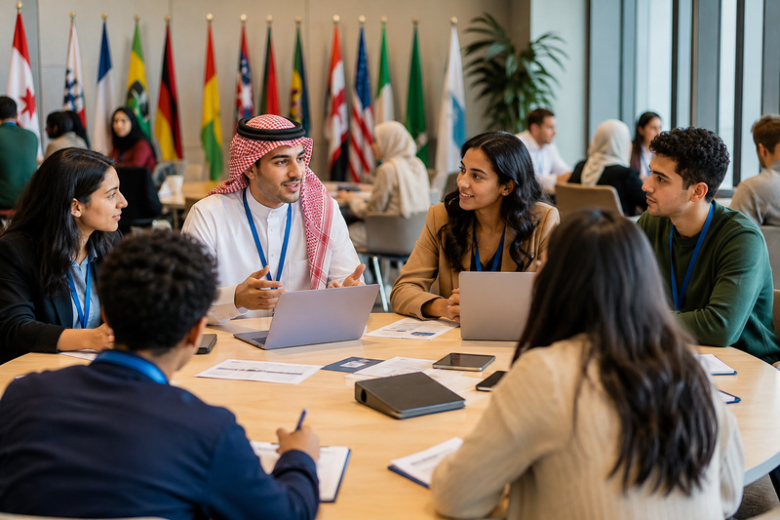
The Global Youth Network for Quality and Excellence has been launched in Riyadh to give young people a stronger role in shaping education. The network aims to move youth participation beyond consultation and towards a meaningful role in education policy, planning and decision-making.
The UNESCO Regional Center for Quality and Excellence in Education launched the network on International Youth Day. It brings together young people, education experts, international organisations, institutions and youth networks from around the world.
For students and educators, the initiative could create new opportunities to contribute to discussions about curricula, learning environments, digital education and the skills young people need.
Global Youth Network Aims To Strengthen Youth Participation
The new Global Youth Network for Quality and Excellence seeks to give young people a sustained role in education development.
Abdulrahman Al-Mudaires, the centre’s director general, said young people were partners in development and in shaping the future.
He stressed the importance of moving youth participation beyond symbolic representation. Instead, young people should be involved in designing, implementing and evaluating educational initiatives and policies.
Fatimah Al-Roais, the centre’s assistant director general, said the network would seek to turn the diverse challenges facing young people into opportunities for innovation and educational solutions.
She said the network would also empower young people to contribute to policies, curricula and learning environments. In addition, it will support skills development in digital technologies, artificial intelligence, critical thinking and innovation.
Youth Council Will Shape The Network
The network’s 2026 to 2027 activation plan includes five stages. These are launch and joining, establishment and governance, operation, expansion and impact, and sustainability and renewal.
The plan aims to create a sustainable international youth platform with clear programmes, outputs and impact indicators.
A global youth council will form a key part of the network. It is designed to support geographical balance and cultural and linguistic diversity.
The council will also include representation for young people with disabilities and those affected by crises.
Members will represent youth voices, contribute to plans, propose initiatives and lead dialogues. They will also represent the network internationally.
As a result, the structure is intended to give young people a more direct role in shaping the network’s priorities and activities.
Education And Future Skills At The Centre
Felipe Paullier, UN assistant secretary-general for youth affairs and head of the UN Youth Office, highlighted the importance of youth leadership in responding to major global challenges.
These include technological transformation, inequality, conflicts and climate challenges.
He also stressed the need to invest in future skills and ensure equitable access to quality education and lifelong learning.
This focus is particularly relevant to schools and universities. Young people are not only preparing for employment. They are also entering a world shaped by artificial intelligence, digital technologies and rapidly changing skills requirements.
Giving students a role in these conversations can help education systems better understand the experiences and expectations of the learners they serve.
Saudi Arabia Places Greater Focus On Youth Participation
The launch comes as Saudi Arabia continues to strengthen its national focus on youth development.
The Ministry of Human Resources and Social Development launched its Youth Development Strategy in January 2024. The strategy was developed with more than 30 government and private entities and includes initiatives designed to increase youth participation in decision-making and community life.
The ministry has since reported more than 20 initiatives under the strategy. It has also conducted workshops involving young people and organisations working with youth.
In December 2025, the ministry launched the General Policy for Youth Development. The policy focuses on five areas, including economic empowerment, community engagement, education and lifelong learning, health and wellbeing, and identity and national belonging.
The policy was informed by benchmarking with 20 countries, more than 34 workshops and surveys involving more than 11,000 young people across Saudi Arabia.
What The Network Could Mean For Students
For young people, the Global Youth Network for Quality and Excellence could create a route into international education discussions.
Students could have opportunities to share experiences and contribute ideas about learning, technology and education policy.
For educators, the initiative also reinforces the value of listening to students when developing learning environments and programmes.
Meanwhile, education leaders can gain a better understanding of the challenges young people face across different countries and communities.
The emphasis on inclusion is also significant. Representation of young people with disabilities and those affected by crises could help ensure that education discussions include perspectives that are sometimes overlooked.
A Wider Shift Towards Youth Voice In Education
The Riyadh-based initiative reflects a wider shift from treating young people solely as recipients of education towards recognising them as contributors to education systems.
That distinction matters. Consultation can give students an opportunity to express their views, but institutional participation gives them a greater role in influencing decisions.
For Saudi Arabia, the network also fits with national efforts to increase youth participation across social, economic and civic life.
Ultimately, the success of the Global Youth Network will depend on whether young people’s contributions lead to visible outcomes. If their ideas influence policies, programmes and learning environments, the initiative could provide a meaningful model for youth participation in education.
For more information please visit
Further Reading
- Saudi School Calendar 2026 To 2027 Key Term Dates And Holidays For Parents
- Saudi Schools Prepare For Students’ Return As New Academic Year Begins