











Saudi Arabia’s world-first national AI programme is no longer an experiment. As it enters its second year, the ambition is scaling fast.
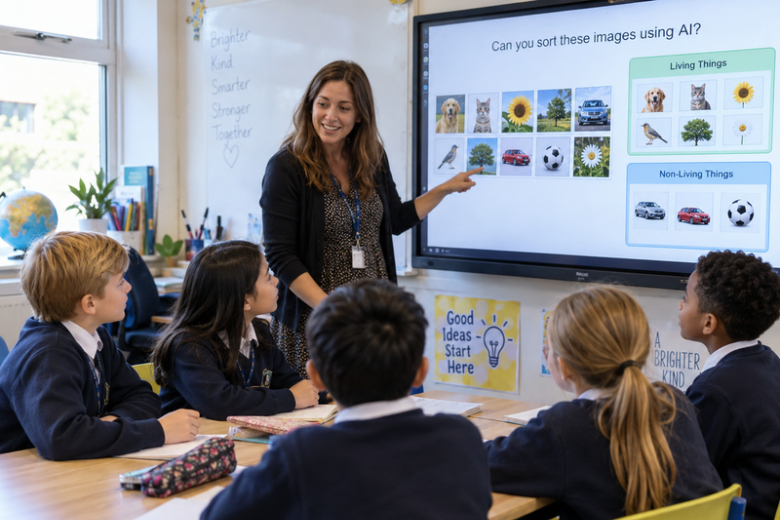
A year ago, Saudi Arabia did something no country had attempted at scale. For the 2025-26 academic year, more than six million public-school students began studying a newly approved artificial intelligence curriculum, spanning elementary through secondary level and developed jointly by the National Curriculum Center, the Ministry of Education, the Ministry of Communications and Information Technology, and the Saudi Data and Artificial Intelligence Authority (SDAIA).
Year one proved the concept. Year two is about depth.
Fifty New Units, and Counting
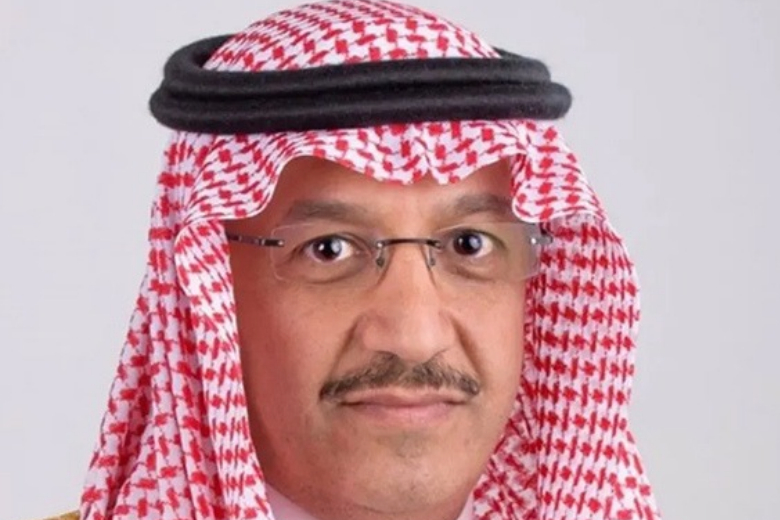
Ahead of the current academic year, Education Minister Yousef Al-Benyan announced that 22 subjects had been updated and 50 new AI learning units added to the curriculum, alongside a new unified Education Portal bringing services onto one platform. The message is clear: AI is not a bolt-on subject but a layer woven through the timetable, taught in age-appropriate modules with AI learning outcomes formally incorporated into the national student performance assessment system. Yousef Al-Benyan, Minister of Education said,
“22 subjects have been updated and 50 educational units in artificial intelligence have been added to the curriculum for the new academic year.”
From the Classroom to the Lecture Hall
The expansion now reaches higher education. In January 2026, at the ICAN conference in Riyadh, SDAIA launched a mandatory National Cross-Disciplinary Curriculum for Data and AI targeting all undergraduates across disciplines at Saudi universities, backed by MoUs with 14 public and private universities. The point, officials stress, is to reach non-specialists, not just computer science students.
BY THE NUMBERS
- 6m+ K-12 students reached in year one (SPA)
- 50 new AI learning units added for year two (Saudi Gazette)
- 14 universities signed up to the undergraduate curriculum (Middle East AI News)
- 2026 designated Saudi Arabia’s Year of Artificial Intelligence
What it Means for Private Schools
Here lies the pressure point for this magazine’s readers. The mandate applies to public schools, but private and international institutions are not exempt from its gravity. Accreditation reviews in the Kingdom increasingly reference alignment with national education priorities, so whether a school follows a British, American or IB curriculum, its AI readiness is now on the radar of every regulator, parent and competitor.
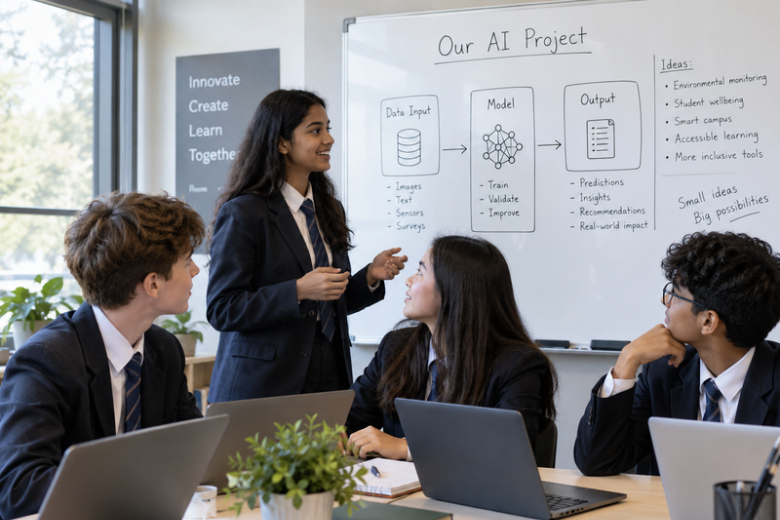
Schools that move early build parent trust. AI readiness has become a differentiator, not a compliance burden.
The trajectory is unmistakable. What began as a pilot for final-year secondary students is now a system-wide commitment from kindergarten to university. For Saudi schools, the question is no longer whether to teach AI, but how well.
Sources: Saudi Press Agency, Saudi Gazette, Arab News, Middle East AI News.
For continued coverage of Saudi Arabia’s education transformation, visit
Further Reading
- Saudi Education Reforms To Change Teacher Hours, AI Use And Professional Development
- Beyond the Classroom, Building the Skills to Thrive at Every Stage