










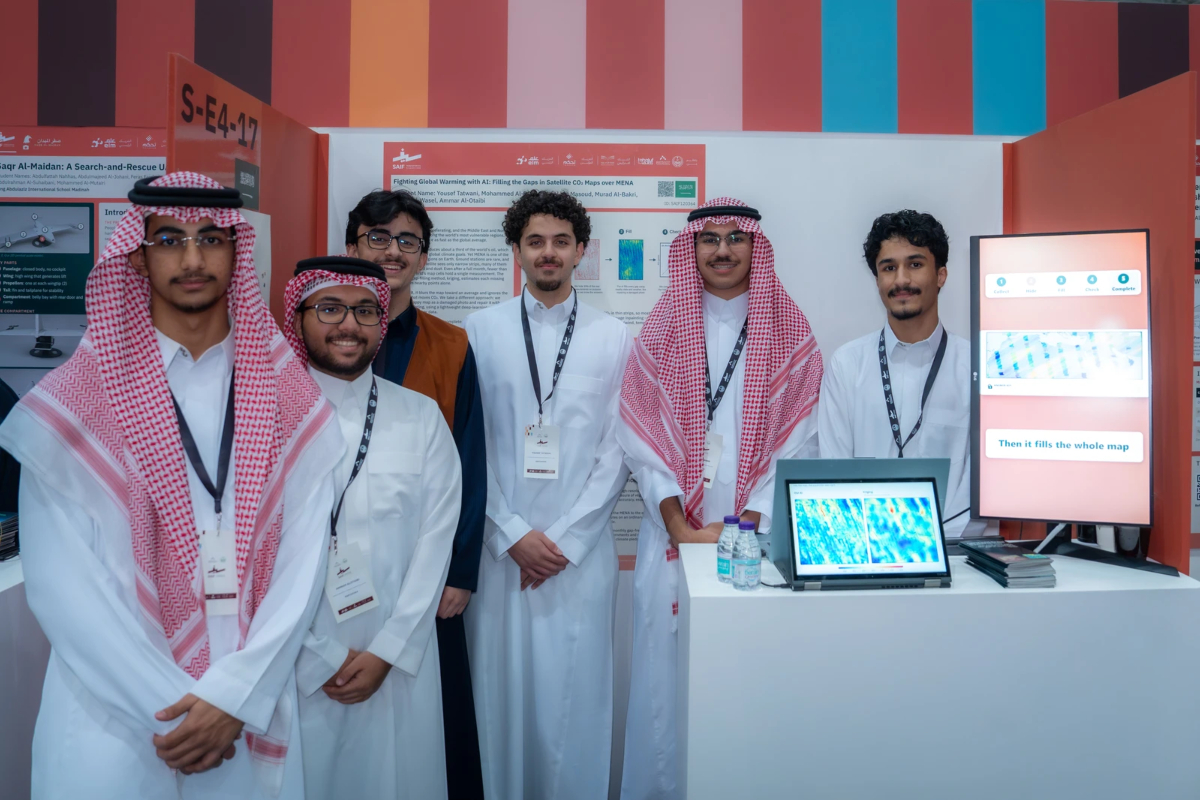
Saudi secondary school students are demonstrating how artificial intelligence can be applied to environmental research and industrial safety at an international innovation competition in Riyadh.
Among the participants at the Security and Innovation Fair (SAIF), running from 24 to 26 November, are students from Riyadh Najed Schools and Future Vision Private School.
Their inventions are being presented alongside approximately 1,200 projects from 55 countries, bringing school-age innovators into the same exhibition environment as researchers, technology specialists and entrepreneurs.
Using AI to Map Carbon Emissions
A team of Saudi secondary school students is developing a tool to address gaps in environmental monitoring across the Middle East and North Africa.
The project applies image inpainting, an artificial intelligence technique used to reconstruct missing visual information, to maps showing carbon dioxide concentrations.
By estimating values in areas where information is incomplete, the students hope their approach could help environmental researchers better identify locations requiring further investigation.
“To actually address a problem, we need to know where it is.”
— Yousef Tariq Tatwani, Grade 12 student, Riyadh Najed Schools, speaking to Arab News
The project demonstrates how skills in computing, mathematics and environmental science can be combined within a single research challenge.
Its estimates would, however, require scientific validation before they could be relied upon for environmental decision-making.
Three Sisters Explore Industrial Safety
Another student-led project, EchoShield, has been developed by three Saudi sisters, including Grade 12 student Rana Shabib Alfowaires of Future Vision Private School.
The prototype combines sensor information with artificial intelligence to identify potential hazards at oil and gas facilities.
The idea originated as a classroom project and was subsequently developed with guidance from their father, an engineer at Aramco, according to reporting by Arab News.
The project is designed to help identify unusual conditions and issue warnings, rather than replace existing industrial safety systems.
Beyond the School Curriculum
Organised by Saudi Arabia’s Ministry of Interior in cooperation with Tuwaiq Academy, SAIF covers 14 areas of innovation, including artificial intelligence, robotics and cybersecurity.
For participating students, the competition offers opportunities to present their research, explain their technical decisions and receive feedback from industry specialists.
It also provides examples of how classroom projects can develop into more ambitious research through experimentation, collaboration and mentorship.
Further Reading
- The AI Curriculum Enters Its Second Year
- Saudi Schools Partnership Brings English, AI and Coding Skills to Al-Qassim Students
- University Student’s Guide to Verifying Research and Academic Sources