












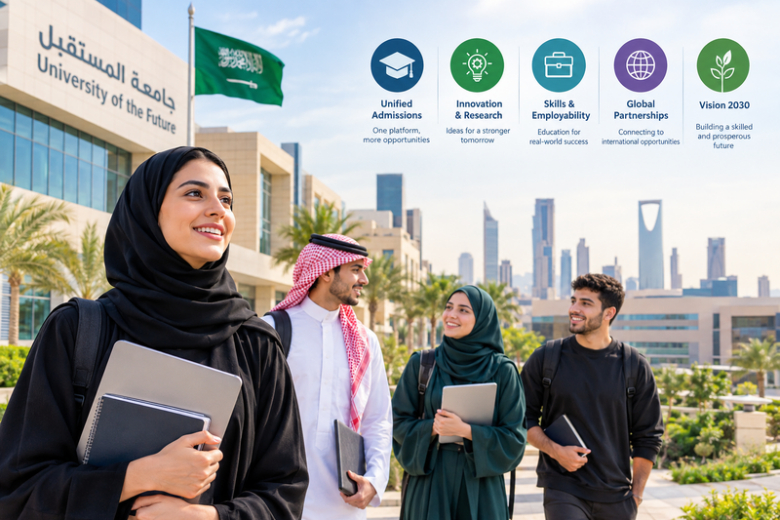
Saudi Arabia is reshaping its higher education system as universities place greater emphasis on employability, research, innovation and access. The Saudi higher education reform agenda is also changing how students apply to universities and how institutions connect their programmes with national development priorities.
For students and families, one of the most visible changes is the move towards a more unified admissions experience. The Ministry of Education launched the national unified admissions platform, Qabul, in 2025 to bring applications to participating universities and educational institutions together through a single digital system.
The wider direction is closely linked to Saudi Vision 2030 and the Human Capability Development Programme. For universities, this means greater attention to the skills students develop, the quality of research produced and the relationship between higher education and the labour market.
Saudi Higher Education Reform Puts Students At The Centre
The current direction of Saudi higher education reform is designed to make the university experience more accessible and responsive to changing needs.
The Ministry says the unified admissions platform gives students access to updated information when choosing programmes and specialisations. It also uses data and digital tools to support academic decision-making.
The platform currently covers 28 government educational entities, including 26 universities, alongside the Technical and Vocational Training Corporation and the Custodian of the Two Holy Mosques External Scholarship Programme’s Emdad pathway for bachelor’s students.
For students, this could make the application process easier to navigate. It also gives institutions access to more consistent information for planning student capacity and university places.
However, the changes extend beyond admissions.
Saudi universities are increasingly being encouraged to develop programmes and research that respond to economic and social priorities. The Ministry has highlighted research advancement, entrepreneurship, technology adoption and international collaboration as important areas for university development.
New University Models And Emerging Fields
The source material for this story describes plans for new universities and colleges focusing on areas including artificial intelligence, renewable energy and biotechnology.
These fields are also consistent with the wider direction of Saudi higher education policy, which is placing greater emphasis on research, innovation and skills linked to national development.
However, the supplied material does not provide sufficiently reliable evidence for the claim that exactly 12 new universities and colleges are being established. The section containing that figure is partially corrupted. It is therefore not presented here as a confirmed current figure.
For students choosing future subjects, the broader shift remains significant. Universities are being encouraged to strengthen links with industry and develop academic programmes that reflect emerging areas of work.
This creates opportunities for students interested in technology, science, entrepreneurship and other fields connected with the changing Saudi economy.
A More Unified University Admissions System
One of the clearest changes already in place is the national unified admissions platform.
The Ministry launched Qabul to standardise university admissions procedures and give students a single digital entry point for participating institutions. It is intended to improve equality of opportunity while helping students compare specialisations using current information.
The system also gives universities and policymakers access to real-time data and analytical reports. These tools can support planning around capacity, student numbers and available places.
For families, the practical significance is straightforward. Instead of navigating multiple admissions processes independently, students can use a central platform for participating institutions.
The system does not mean that every university or every programme has identical admission requirements. Students still need to meet the conditions set for the programmes and institutions they apply to.
Scholarships Continue To Support Global Study
Saudi Arabia’s higher education changes also include a strong international dimension.
The Custodian of the Two Holy Mosques Scholarship Programme has several pathways designed to develop human capital and support national development. The programme’s current structure includes four pathways.
The Pioneers pathway, for example, supports students seeking study opportunities at the world’s top 30 educational institutions. Another pathway, Promising, focuses on scholarships and training linked to promising sectors and fields.
The Ministry has also expanded the range of disciplines available through scholarship routes. These include areas such as business, tourism, hospitality, environmental sciences, sports management and public policy, alongside scientific and technical disciplines.
For Saudi students, this means that international study opportunities are increasingly connected to defined academic and workforce priorities.
Universities Given Greater Responsibility For Their Development
Saudi Arabia’s university reforms also give institutions greater responsibility for shaping their academic and administrative development.
The country’s new university system provides universities with regulated autonomy, allowing them to develop academic, financial and administrative regulations within national policy frameworks. It also enables institutions to establish programmes and specialisations according to development needs and employment opportunities in the regions they serve.
This approach gives universities more scope to respond to local economic needs.
At the same time, performance indicators are used to assess university performance, including educational, research and administrative areas.
For educators and university leaders, this places greater importance on demonstrating outcomes rather than simply expanding programmes.
Research And Industry Links Take Greater Importance
Research is another major part of the country’s higher education direction.
The Ministry has highlighted collaboration between universities, industry and knowledge institutions in Saudi Arabia and internationally. It has also reported the activation of research and innovation centres in partnership with the Research, Development and Innovation Authority.
These partnerships can give students and researchers greater opportunities to work on projects connected with real-world challenges.
Furthermore, closer links between universities and employers can help institutions understand the skills required by emerging industries.
For students, the benefit is not limited to employment after graduation. Industry-linked projects, research opportunities and entrepreneurship programmes can also provide practical experience during university.
What The Changes Could Mean For Students
Saudi Arabia’s higher education reform is creating a system in which students are expected to make increasingly informed decisions about their academic pathways.
The unified admissions platform can simplify the application process. Scholarship pathways can provide access to international universities and specialised programmes. Meanwhile, university autonomy can allow institutions to develop courses that respond more closely to regional and national needs.
For parents, the changes make it increasingly important to look beyond a university’s name when considering higher education options.
Students should examine the specialisations available, admission requirements, research opportunities, industry partnerships and potential progression routes before making decisions.
Educators and school counsellors also have an important role to play. They can help students understand how subject choices, academic performance and personal interests connect with different university pathways.
Saudi Higher Education Enters A New Phase
Saudi Arabia’s higher education reform is not a single change to university admissions or curriculum. It is part of a wider restructuring of how higher education supports students, research and national development.
The direction is already visible through the unified admissions platform, expanded scholarship pathways, stronger research partnerships and greater institutional responsibility.
At the same time, some claims in the original source about new institutions and specific participation targets require further official confirmation before publication.
For students and families, the central message is that Saudi higher education is becoming more closely connected to skills, research, employment and the country’s wider development priorities.
As these changes continue, understanding the new pathways will become increasingly important for students planning their next step after secondary school.
For more education updates, please visit
Further Reading
- Beyond The Balloons, What Saudi Children Really Need In Their First Week Of School
- Bear Hugs Eyes 15 New Saudi Nurseries As Early Childhood Sector Grows