












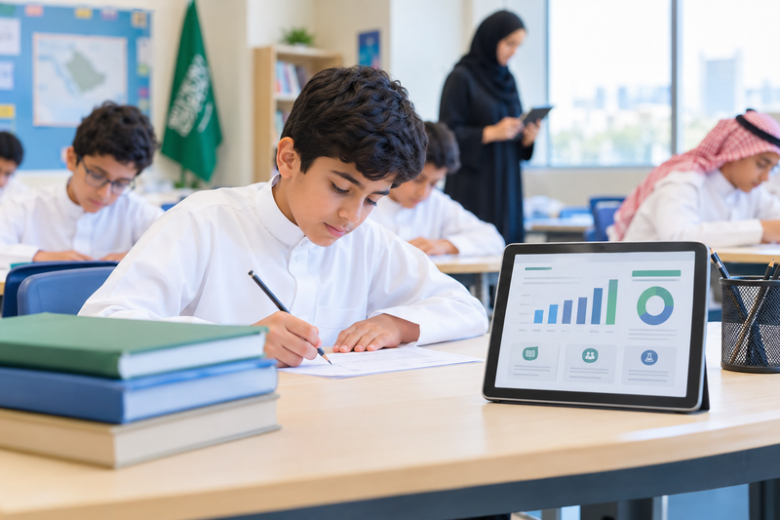
Saudi school performance cards for 2026 have been released by the Education and Training Evaluation Commission, giving schools, education administrations and parents more detailed information about educational performance.
The 2026 Educational Performance Cards are based on the results of the National Assessment (NAFS), which involved more than 1.3 million students. The cards provide indicators that can help schools identify strengths, monitor changes and understand areas that may need further improvement.
For families, the information comes as the new 1448–1449 AH academic year begins. It offers another source of information when parents are researching schools and considering their options.
What The Saudi School Performance Cards Show
The Saudi school performance cards provide indicators linked to school performance and student achievement.
Unlike a single examination result, the cards bring together a wider set of information. They allow performance to be considered at both school and education administration level.
Furthermore, the cards are part of an ongoing approach to measuring education quality in Saudi Arabia. This means schools can look at changes in their results over time rather than focusing only on one year’s figures.
For school leaders and educators, this can support discussions around areas of strength and opportunities for development.
How NAFS Results Feed Into School Performance
The 2026 Saudi school performance cards are based on NAFS national assessment results.
The assessments were conducted from April 5 to April 23, 2026, in cooperation between the Education and Training Evaluation Commission and the Ministry of Education. More than 1.3 million students participated.
The assessment covered three key stages,
- Third grade of primary school, covering Mathematics and Reading.
- Sixth grade of primary school, covering Mathematics, Reading and Science.
- Third grade of middle school, covering Mathematics, Reading and Science.
NAFS is designed to measure achievement in core areas and monitor changes in students’ learning over time. ETEC’s guidance also describes the national assessments as a way to provide reliable performance indicators for educational improvement.
What The Results Mean For Schools And Educators
For schools, the performance cards can provide a clearer picture of educational outcomes.
The information can help school leaders examine performance, identify areas that require attention and consider where further development may be useful.
Meanwhile, NAFS results can help educators understand achievement in the areas assessed. ETEC’s parent guidance explains that national assessments can help educators and parents monitor students’ proficiency in Reading, Mathematics and Science over time.
Therefore, the value of the cards extends beyond reporting results. They can contribute to a wider cycle of assessment, reflection and school improvement.
What Parents Should Know About School Performance
The release of the Saudi school performance cards also gives parents another source of information when researching schools.
However, performance indicators should not be considered in isolation. The available guidance recommends looking at factors such as location, educational stage, curriculum, tuition fees, programmes, facilities, services and the individual needs of the student.
This is particularly relevant at the beginning of a new academic year, when families may be considering a school move or preparing for a new educational stage.
Parents can use performance information to ask more informed questions about a school. They can also consider how its educational approach matches their child’s needs.
Performance Cards Are Not A Standalone School Ranking
The Educational Performance Cards should not be treated as an official list ranking every school from highest to lowest.
Their purpose is to provide indicators that help assess performance, track changes and identify strengths and areas for improvement.
This distinction matters for families. A school’s performance indicator is one part of a much broader picture.
A school that suits one student may not necessarily suit another. Consequently, parents can consider assessment information alongside curriculum, school environment, location, fees and available support.
Where Schools Can Access The Performance Cards
Schools and education administrations can access the Educational Performance Cards through ETEC’s Tameez digital platform. Additional education data and analytical dashboards are available through the Education and Training Situation Room.
ETEC’s digital platform describes school evaluation as a process that gathers information about school performance, identifies strengths and opportunities for improvement, and supports educational development.
For parents, ETEC also provides school performance information through its wider parent-focused services. Its Mustaqbalhum programme includes a School Card designed to provide parents with detailed information about the performance level of their children’s schools.
Why The 2026 Cards Matter For Saudi Education
The continued release of school performance information reflects a wider focus on using assessment data to understand learning outcomes.
For educators and school leaders, consistent data can support longer-term monitoring. For parents, it can provide another evidence-based reference when comparing schools.
Ultimately, the 2026 Saudi school performance cards are most useful when viewed as part of a broader picture of school quality.
As families begin the 1448–1449 AH academic year, the information gives them another way to understand school performance while keeping the needs of each individual student at the centre of the decision-making process.
For more information please visit,
Further Reading
- Saudi Universities Strengthen Their Global Standing In The 2026 Rankings
- International Education In Saudi Arabia Is Supporting New Global Communities