












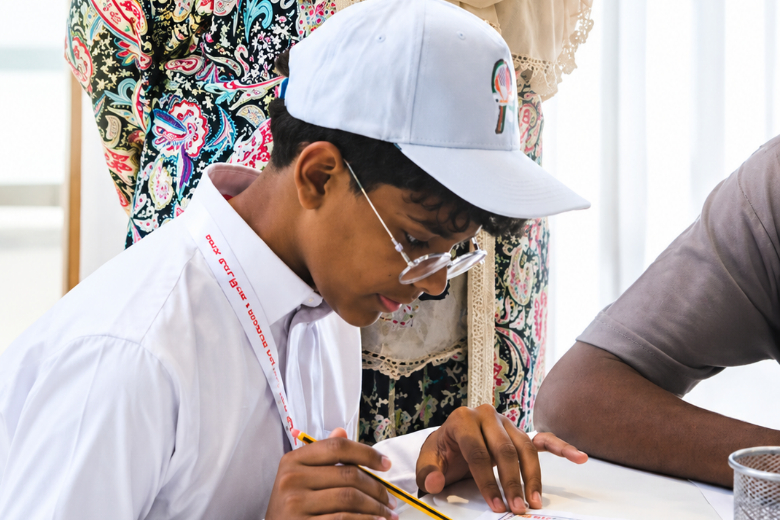
For many children, science and technology begin as school subjects. But when students are given the opportunity to experiment, build, code, investigate and solve problems for themselves, STEM can become much more than something they study in a classroom.
Science, technology, engineering and mathematics can introduce young people to a wide range of interests and potential future pathways, from robotics and environmental science to engineering, architecture, coding and sustainable development.
This is why hands-on STEM experiences can be particularly valuable. They allow children to see how different subjects connect and give them the opportunity to discover what they enjoy through practical experience.
A recent summer camp at the Red Sea Museum in Historic Jeddah provides an example of how this approach can work.
Designed by Saudi interdisciplinary learning organisation Takween, Home of Design & Innovation, the five-day programme brought together science, technology, engineering, arts and mathematics with architecture, design and practical projects.
Rather than sitting through traditional lessons, children investigated the Red Sea, studied marine habitats, created a collaborative map and used coding and robotics to explore how different ecosystems are connected.
STEM Can Help Children Learn By Doing
One of the most valuable aspects of STEM learning is the opportunity to move from understanding a concept to applying it.
At the Red Sea Museum camp, students began by exploring the geological forces that shaped the Red Sea. They then investigated habitats including coral reefs, seagrass meadows, mangroves and open water.
The children used what they had learned to create a large collaborative map, identifying coastal cities, coral reef systems, shipping routes, marine protected areas, research stations, species and habitats.
They then moved into coding and robotics, programming robots to represent fish travelling between different marine environments.
This kind of activity shows children that knowledge does not have to remain within one subject. Geography, biology, technology, coding and engineering can work together to explore a single question or problem.
That can help make STEM more relevant and encourage children to think about how what they learn could be applied in the real world.
From Curiosity To Problem-Solving
STEM is also about the process of finding answers.
At Takween’s camp, children were encouraged to make predictions, test their ideas and then refine their understanding. Instead of immediately being given an answer, they were given the opportunity to investigate first.
This can help develop important skills such as critical thinking, problem-solving and communication.
Making mistakes is also an important part of this process. A child whose first attempt does not work has an opportunity to ask why, make a change and try again.
That experience can help children become more comfortable with experimentation and uncertainty, both of which are important parts of scientific and technological work.
The camp also gives students opportunities to work together. Building a large map or developing a project requires children to listen to one another, divide tasks, share ideas and communicate their thinking.
These are skills that can be useful far beyond STEM subjects.
A Chance To Discover Future Interests
Children do not always know which subjects or careers they might enjoy, particularly when they have had limited opportunities to explore them.
A practical STEM experience can provide an introduction to areas that students may not encounter in depth during their normal school day.
A child interested in building and designing may discover architecture or engineering. Another who enjoys coding could become curious about robotics or computer science. A student fascinated by the Red Sea and its wildlife may develop an interest in marine science, conservation or environmental research.
Takween’s programmes cover areas including architecture and interior design, marine science, environmental innovation, robotics, physical computing, wearable technology, light and optics, heritage and sustainable cities.
The breadth of these areas highlights how wide the STEM landscape can be.
It is also important that children do not need to choose a career simply because they enjoy one STEM activity. The value of early exposure can instead be in helping them understand what is possible and giving them the confidence to explore further.
Why Experiences Like Summer Camps Matter
School holidays can give children time to explore interests in a different setting, particularly through programmes that prioritise practical learning.
A STEM summer camp can provide an opportunity to experiment without the pressure of a conventional classroom lesson. Students can work on projects, ask questions, collaborate with others and see how their ideas develop.
At the Red Sea Museum camp, the local environment also became part of the learning experience. Children were not studying an abstract ecosystem from a textbook. They were exploring the Red Sea and thinking about the marine environment surrounding their communities.
That can give STEM learning another layer of meaning.
The programme also ends with students presenting their work and responding to questions about the solutions they have developed. This adds communication and confidence to the technical and scientific skills they have been developing throughout the camp.
For parents, this is an important part of looking at STEM opportunities for children. The benefit is not simply learning how to code or understanding a scientific concept. It can be the combination of curiosity, creativity, teamwork, problem-solving and the confidence to explain an idea.
Opening The Door To Possibilities
STEM education can give children an early glimpse into a world of possibilities.
Through practical experiences, students can begin to understand that science can connect with technology, that engineering can connect with sustainability and that coding can be used to explore real-world problems.
The Takween summer camp at the Red Sea Museum is one example of how children can experience this approach, moving from geological investigations and marine research to mapping, coding and robotics within a single programme.
For young students, the biggest outcome may not be mastering a particular piece of technology or learning a specific scientific fact. It may simply be discovering a question they want to keep exploring.
That curiosity can be the starting point for a much wider journey through STEM.
For more details please visit
Further Reading
- Downe House Riyadh Strengthens Leadership Team For 2026/27
- Riyadh Schools Move To Remote Learning For A Week Through Madrasati