













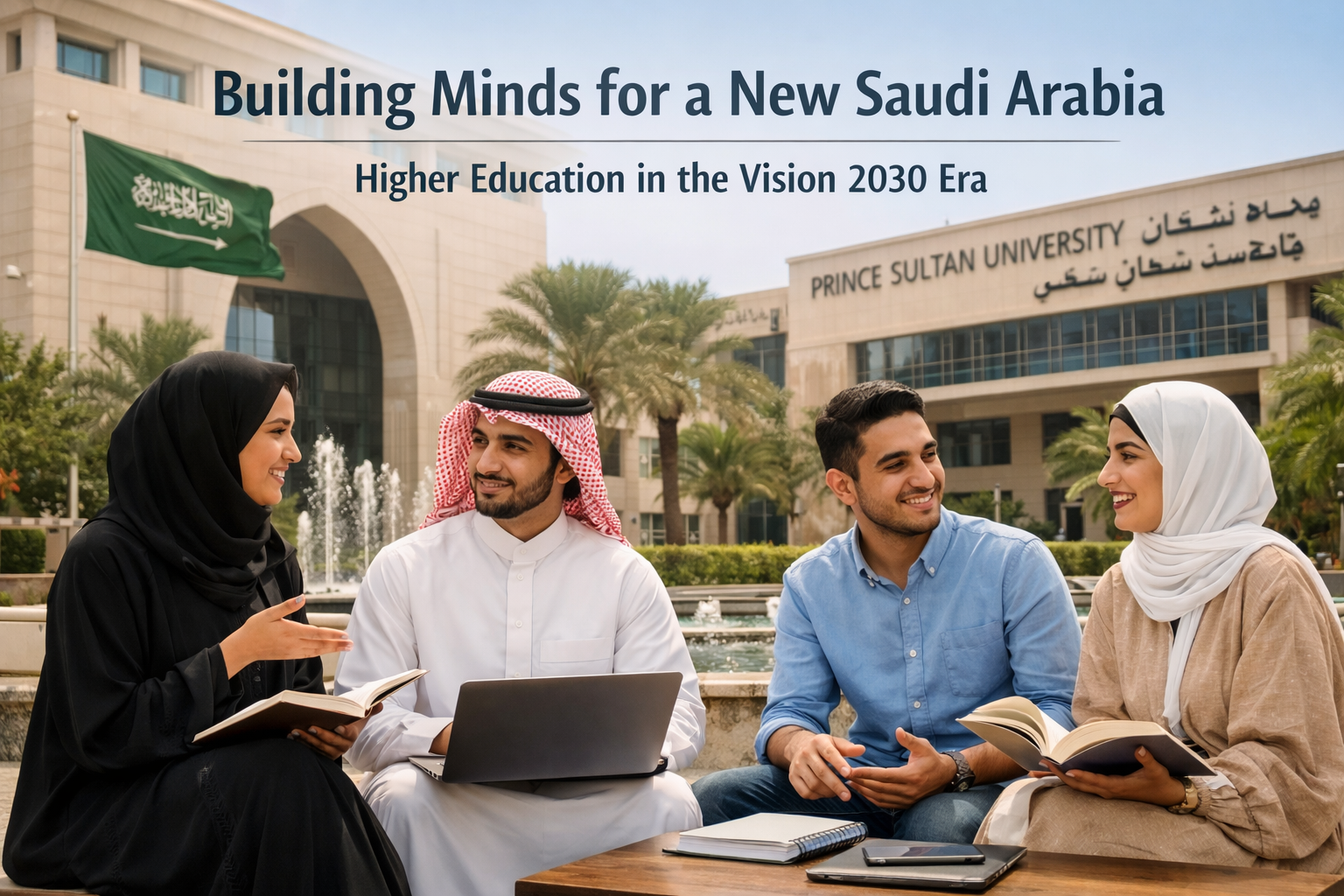
As Saudi Arabia accelerates its transformation under Vision 2030, higher education institutions are redefining their role in shaping not only employable graduates but responsible global citizens. Dr Ahmed S. Al Yamani, President of Prince Sultan University, outlines how the university is aligning national priorities with international academic standards while driving innovation, collaboration, and long-term impact.
Shaping Global Citizens Beyond Employability
Universities today must educate for life, leadership, and responsibility, not only for employment. At Prince Sultan University (PSU), we view global citizenship as the ability to think ethically, act responsibly, collaborate across cultures, and contribute meaningfully to society. While employability remains essential, it is no longer sufficient on its own.
We emphasise values-based education, critical thinking, digital literacy, sustainability awareness, and civic engagement across all disciplines. Experiential learning, interdisciplinary projects, community partnerships, and exposure to global challenges help students understand their role in shaping the future. Our goal is to graduate individuals who are not only career-ready but also future-ready, capable of navigating uncertainty, leading with integrity, and contributing to global well-being.
Aligning with Vision 2030 While Maintaining Global Standards
Saudi Vision 2030 calls for a knowledge-based, innovative, and globally competitive society. PSU’s alignment with this vision is both strategic and measurable. Through our Strategic Plan, we integrate national priorities, human capability development, digital transformation, sustainability, privatisation, and research commercialisation directly into curriculum design, research agendas, and institutional governance.
At the same time, PSU maintains strong international academic standards through global accreditation, benchmarking, and quality assurance frameworks. We continuously align our programmes with international best practices while ensuring relevance to national needs. This dual focus allows us to serve as a bridge between global knowledge ecosystems and Saudi Arabia’s ambitious transformation agenda, producing graduates who can compete internationally while contributing locally.
The Role of International Collaboration
International collaboration is central to PSU’s academic strategy. We prioritise partnerships that are purpose-driven and impact-oriented, rather than symbolic. Our collaborations with global universities, accreditation bodies, industry leaders, and international organisations focus on joint research, faculty exchange, co-developed programmes, and student mobility.
These partnerships have strengthened research output, expanded interdisciplinary work in areas such as AI, sustainability, engineering, and health sciences, and enhanced student exposure to diverse academic and cultural environments. More importantly, they have helped our faculty and students engage with global challenges through local solutions, ensuring that learning and research are both internationally informed and socially relevant.
Driving Institutional Reform and Innovation
One of the most significant reforms at PSU has been the integration of quality assurance, sustainability, and digital transformation into a single institutional ecosystem rather than treating them as separate initiatives. We have embedded outcome-based assessment, evidence-driven decision-making, and continuous improvement across all academic and administrative units.
Additionally, our focus on AI-enabled education, ethical technology use, and interdisciplinary innovation reflects a forward-looking approach that many universities are now adopting. By aligning governance, accreditation, innovation, and sustainability under one strategic vision, PSU demonstrates how universities can remain agile, accountable, and future-oriented in a rapidly changing global landscape.
Advice for Global Education Leaders
My advice is simple but demanding: lead with purpose, evidence, and courage. Uncertainty is no longer an exception it is the norm. Education leaders must move beyond reactive planning and instead build institutions that are adaptable, values-driven, and learner-centred.
Invest in people, trust data, and embrace technology responsibly, while never losing sight of education’s human mission. Universities must remain spaces where innovation is guided by ethics, where technology serves humanity, and where students are prepared not only for the jobs of tomorrow, but for the responsibilities of global citizenship. The future belongs to institutions willing to reimagine themselves while staying true to their core values.
For more information, please visit