












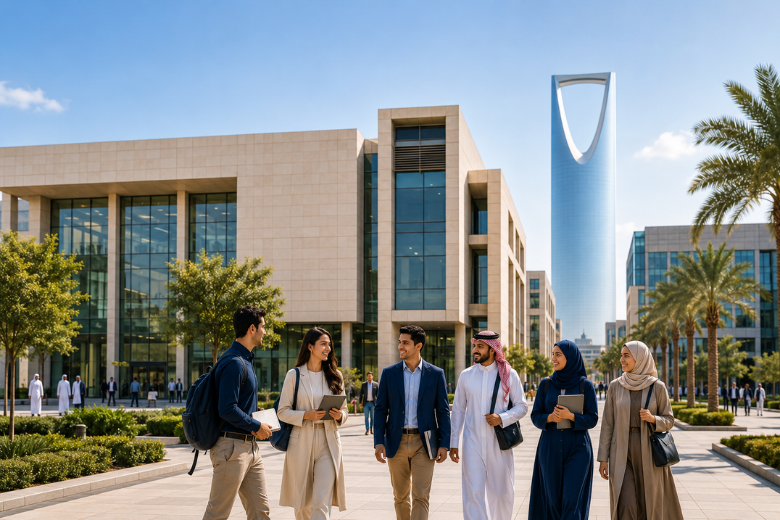
Saudi Arabia’s foreign university expansion is gathering pace with the launch of the University of New Haven Riyadh, marking an important development for students, educators and the wider Gulf higher education sector. While regional tensions continue to create uncertainty across the Middle East, Saudi Arabia is pressing ahead with plans to strengthen its higher education landscape through international partnerships.
The new campus is expected to open in autumn 2026 in Misk City and will become the first foreign university campus established in Saudi Arabia. The move reflects the Kingdom’s ambition to expand higher education opportunities while supporting its long-term workforce and economic goals.
University of New Haven Riyadh Prepares to Welcome Students
The University of New Haven (UNH) Riyadh campus has received approval from its accreditor, the New England Commission of Higher Education (NECHE), and will offer five undergraduate and two postgraduate programmes through its College of Business and Digital Innovation.
Courses will focus on business, technology, analytics and sport, all areas that closely align with Saudi Arabia’s future employment priorities. Dr Leo Lester, Senior Vice-President for UNH Riyadh, explained that the university will operate through student tuition fees while developing scholarship opportunities with industry partners.
He also revealed that the university was unaware why it had not appeared on the Saudi Ministry of Investment’s 2024 list of approved foreign branch campuses despite already holding a foreign investor licence. Nevertheless, it became the first institution to formally submit its application.
According to Lester, the application process involved producing a detailed 1,750-page submission from an original 34-page draft to satisfy Saudi Arabia’s regulatory requirements.
Strong Demand Highlights Higher Education Opportunities
Interest in the new campus has already exceeded expectations. Lester said that by early May the university had received more than 4,000 expressions of interest and 250 formal applications.
He attributed this demand to three key factors. Firstly, around 200,000 Saudi students complete secondary school each year without meeting admission requirements for local universities. Secondly, changes to the Custodian of the Two Holy Mosques’ External Scholarship Programme have altered overseas study opportunities. Thirdly, growing uncertainty around studying abroad has encouraged more families to consider high-quality international education closer to home.
UNH Riyadh will offer US-accredited degrees, a co-educational learning environment and opportunities for eligible students to study for a semester at the university’s campuses in Connecticut and Italy.
The campus will welcome Saudi nationals, expatriate residents, including Iqama holders, and international students. Meanwhile, faculty recruitment is already underway. Several academics from the university’s US campuses have agreed to relocate temporarily, while additional positions remain open to international lecturers and Saudi academics.
Arizona State University Takes a Different Approach
Arizona State University (ASU) had previously been expected to establish its own branch campus in Riyadh. However, after months of limited updates, ASU instead announced a strategic partnership with Riyadh-based Kingdom University.
The partnership will launch in September 2026 with a foundation programme before introducing degree programmes focused on STEM, digital innovation and workforce-aligned professional pathways.
Students will study in Riyadh while earning both a Saudi degree from Kingdom University and an internationally recognised degree from Arizona State University through the ASU-Cintana Alliance. In addition, students will have opportunities to continue their studies in the United States or access UK degree pathways through ASU London.
What this Means for Saudi Higher Education
A Saudi academic working at a public university welcomed the arrival of UNH Riyadh, describing it as a positive development for both capacity and quality. Reflecting on employment opportunities for Saudi academics he said,
“It is genuinely good news for the market, especially with the capacity challenge, but also for quality and competition. If early appointments tend to be short term, I would say thatis a normal feature of any new branch campus during its operational phase, and it should not overshadow the wider opportunity. Probably, this is the explicit benefit, but I believe there are implicit benefits, such as research ventures, quality and opportunity exchange.”
He also believes foreign universities could reshape the country’s higher education landscape.
“First, this campus should be seen as part of a broader, healthy trend, not an isolated event. It can serve as a positive disruptor for the higher education sector,” he said. “The presence of a US-accredited branch campus will create real comparative pressure in the system for the first time in a generation. It is a real test. Second, this new American campus will give Saudi families a credible local alternative to sending their children abroad. This aspect, in my opinion, will be the key driver for sustainability of the UNH branch and future branch campuses.”
Why this Matters for the UAE and Gulf Education Sector
For educators and education leaders across the UAE, Saudi Arabia’s growing interest in international branch campuses signals increased competition within the regional higher education market. Moreover, it demonstrates that Gulf countries continue to invest in international education partnerships despite geopolitical uncertainty.
For students and parents, the expansion creates more opportunities to access internationally recognised degrees without leaving the region. It may also encourage universities across the Gulf to strengthen programme quality, industry partnerships and graduate employability.
Ultimately, the success of the University of New Haven Riyadh will depend on student demand, academic quality and its ability to meet Saudi Arabia’s ambitious education and workforce objectives over the coming years.
For more details please visit
Further Reading
- Why OWIS Al Jazeera is the Choice for Global Connected Learning in Riyadh
- How Universities are Transforming Saudi AI Graduate Skills for Career Success