












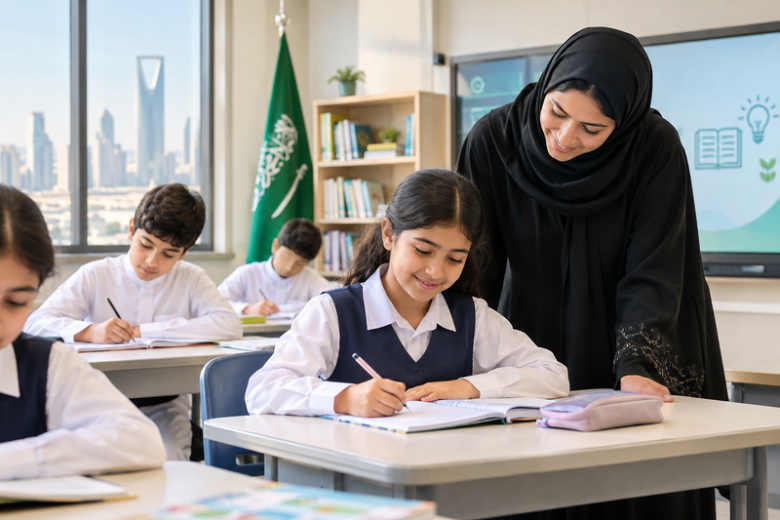
Saudi Arabia’s education transformation is entering a new phase, with reforms now focusing on how changes across schools, teachers, curricula and education providers are put into practice.
A new Oxford Business Group report, produced in partnership with the Ministry of Education, examines how Saudi Arabia is moving from the strategic ambitions of Vision 2030 towards system-wide implementation. The report, Education Transformation 2.0 – Vision to Impact, highlights governance, curriculum development, teacher development and access as key areas shaping the next stage of reform.
For parents, educators and school leaders, the changes matter because they could influence how education is delivered, how schools operate and how students prepare for further study and employment.
A New Framework For Saudi Arabia’s Education System
A major development is the General Education Law, which was approved in July 2026. The legislation establishes a more unified framework for general education and clarifies the responsibilities of different institutions across the sector.
The law covers areas including educational institutions, learning pathways, e-learning, student and teacher rights and the wider learning environment. It also provides a framework for private and non-profit participation in education.
This creates a clearer structure for schools and education providers as the Kingdom continues to develop its education system.
The Ministry of Education has also been working to strengthen cooperation with private and non-profit organisations. At the 2026 Education and Training Investment Forum, Education Minister Yousef Al-Benyan said the sector was being developed through legislative, regulatory, operational and financial measures designed to support participation from public, private and non-profit organisations.
For school leaders and education suppliers, the changing regulatory environment will therefore be important to follow as further implementation details emerge.
What The Education Transformation Means For Schools
The education transformation extends beyond legislation. The OBG report examines changes in curriculum design, teacher development, governance and equitable access.
For schools, this means that education reform is increasingly connected to wider questions about learning outcomes and workforce preparation.
The Ministry of Education has also identified teacher empowerment, digital innovation and comprehensive learning pathways among its education development priorities.
Meanwhile, the Kingdom is continuing to develop digital services for families. Its electronic enrolment system allows parents to register children for primary school and kindergarten through a unified online process, supporting more efficient admissions and education planning.
These developments show how education transformation is affecting both classroom provision and the services surrounding students and families.
Early Childhood And Curriculum Development Remain Key Priorities
Early childhood education is another important part of Saudi Arabia’s education transformation.
The Ministry of Education has been expanding kindergarten provision and has set a long-term objective of increasing kindergarten enrolment significantly by 2030.
The OBG report also highlights rising kindergarten participation, alongside developments in school curricula and scholarship programmes.
According to the report, kindergarten enrolment increased from 21% in 2019 to 35% in 2025, with a 40% target for 2026. More than 2,100 private-school curricula were also reviewed and approved for implementation in 2025.
These figures matter to families because early learning can influence children’s preparation for primary education. For educators, the expansion also creates a continuing need for appropriate teaching approaches, professional development and learning resources.
Saudi Arabia is also expanding international education partnerships. In 2025, for example, the Ministry signed agreements with China covering scholarships and curriculum cooperation, including the development of Chinese-language learning in Saudi schools.
Preparing Students For Future Study And Work
Another focus of the education transformation is the relationship between learning and future employment.
The OBG report notes that more than 28,500 Saudi scholarship students were studying at universities ranked among the world’s top 200 in 2025. This exceeded the annual target and supported the development of expertise in priority fields.
For students and families, these pathways provide opportunities to build academic and professional experience beyond the school years.
At school level, the wider direction is also towards learning pathways that connect education with labour market needs and national economic priorities.
The General Education Law includes provisions covering different learning pathways and e-learning. It also strengthens provisions relating to students with disabilities and gifted learners.
This places greater emphasis on providing different routes through education while supporting a wider range of learner needs.
What Happens Next For Saudi Schools?
The publication of the new report comes as Saudi Arabia moves into a period where implementation will be particularly important.
Yousef Al Benyan, Minister of Education, highlights the importance of the legislation in the report. His Excellency said,
“Education stands as the most profound commitment a country can offer to its people. The issuance of the General Education Law in July 2026 marks a pivotal milestone on this journey, establishing a clear legislative foundation for a coherent, accountable and future-ready ecosystem. More importantly, it embeds our national commitment to quality, equity and continuity into the very structures that will govern education for generations to come.”
The General Education Law provides the legal framework, but its impact will depend on how policies and regulations are applied across schools and education institutions. Saudi authorities have indicated that further executive and regulatory provisions will support implementation of the new framework.
Andrew Jeffreys, CEO of OBG, said the next stage will focus on connecting different areas of reform.
“What distinguishes this phase of transformation is coherence rather than scale. Saudi Arabia is aligning governance, curriculum, teacher development and access so that progress in one area reinforces progress in the others. The General Education Law supports this integration, providing a clearer framework for education delivery, innovation and long-term human capability development.”
For parents and students, the key question will be how these reforms translate into everyday educational experiences. For educators and school leaders, attention will increasingly turn to implementation, professional development and learning outcomes.
As Saudi Arabia continues its education transformation, the focus is shifting from setting ambitions to building the structures, services and learning pathways needed to deliver them.
Education Transformation 2.0 – Vision to Impact is available through Oxford Business Group.
For more details please visit
Further Reading
- Saudi Schools Receive 2026 Performance Cards Based On NAFS Results
- Saudi Indonesia Partnerships Expand Higher Education And Research Opportunities