

Bridging the Digital Divide
In the heart of the Middle East’s rapid digital transformation, a paradox has emerged. While over 170 countries have launched national digital strategies, the gap between technological ambition and human expertise is widening. A landmark 2025 whitepaper, “ICT Job Roles and Skills in the Intelligent World” – jointly released by Huawei, IDC, and UNESCO IITE – reveals a sobering reality: the Middle East and Africa (MEA) region is set to face a shortage of approximately 4 million ICT jobs by 2030.
As Artificial Intelligence (AI) fundamentally reshapes every sector, the question for the UAE and its neighbours is no longer if they should adapt, but how fast. Leading this charge is the Huawei ICT Academy, an initiative that has evolved from a training programme into a vital pillar of the region’s socio-economic infrastructure.
The Agility Gap: Why Traditional Education Must Evolve
The whitepaper highlights a critical structural challenge: the “Agility Gap.” In the current landscape, technical knowledge systems refresh every 18–24 months. In contrast, traditional university degree programmes take an average of 5–7 years to update their curricula.
This discrepancy means that by the time a student graduates, their knowledge of cutting-edge fields like AI-native cloud infrastructure or automated threat detection may already be outdated. Currently, 65% of global enterprises report that skill shortages are the primary bottleneck hindering their digital transformation. In the Middle East, where the push for AI-driven “Smart Cities” is paramount, this bottleneck is particularly acute.
Huawei ICT Academy: The Middle East Success Story
To counter this, Huawei has scaled its educational footprint with unprecedented speed. By August 2025, Huawei has cooperated with over 3,500 universities worldwide, training more than 1.8 million students.
The impact is most visible in the Middle East and Central Asia, where the academy has established partnerships with over 330 schools, already benefiting 500,000 students. This isn’t just about quantity; it’s about high-quality, pragmatic training that aligns with the “T.H.E. GOLD Talent” philosophy – a region-specific programme launched in collaboration with UNESCO IITE.
The “AI 100 Schools, 100,000 Talents” initiative (part of the GOLD Talent programme) is a bold commitment to cultivate an additional 1 million digital and intelligent talents over the next decade. By providing the “bricks” of technology and the “mortar” of hands-on practice, Huawei is ensuring that the next generation of Emirati and Middle Eastern professionals are not just participants in the digital economy, but its architects.
The Human Element: Beyond the Data
While the statistics are impressive, the true success of the ICT Academy is found in the stories of the individuals it empowers. The Middle East has become a powerhouse at the Huawei ICT Competition World Finals, a platform where academic theory meets real-world problem-solving.
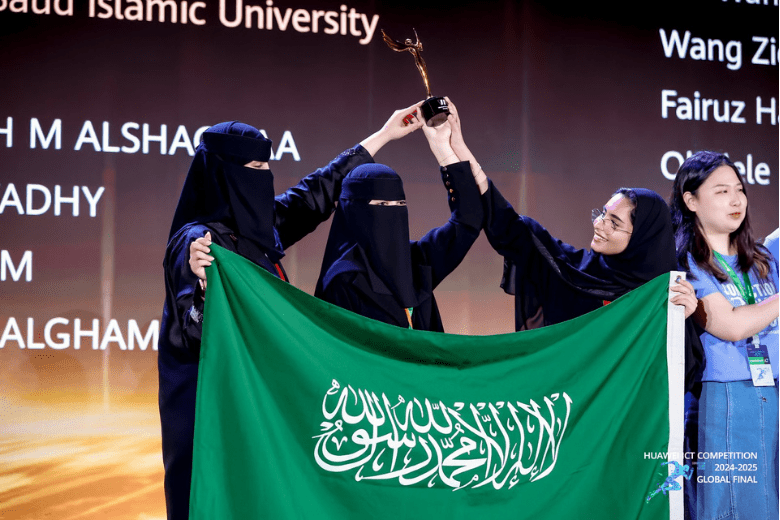
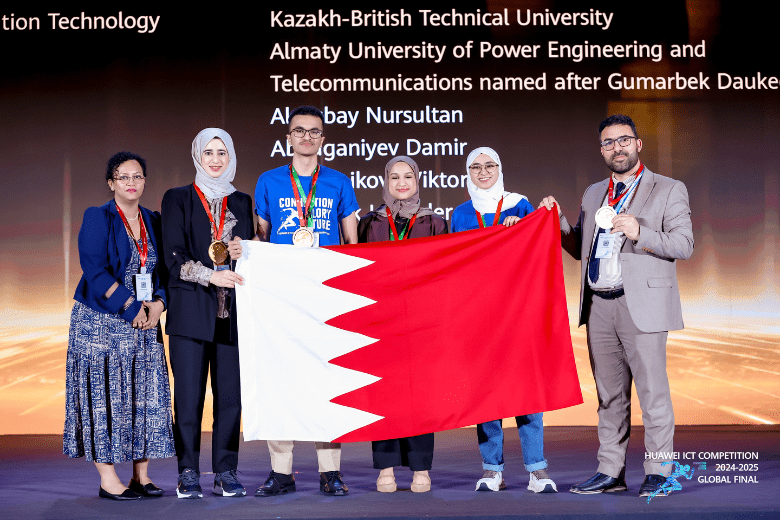
Take, for instance, the recent triumphs of the Saudi Arabian women in tech. Their success at the ICT Competition isn’t just a win for a team; it is a symbol of the shifting cultural and professional landscape in the Kingdom. Similarly, the Bahraini national team’s consistent performance on the global stage demonstrates how targeted investment in ICT education can allow smaller nations to punch well above their weight in the global tech arena.
These competitions do more than test coding skills. As seen in the cases of students like Li Jingzhe – who transitioned from a prize-winning AI project in the ICT Competition to postgraduate studies at Fudan University – the academy serves as a bridge to the world’s most prestigious research institutions and career opportunities. It provides what the whitepaper calls “human-AI collaboration” skills, blending technical literacy with strategic oversight.
A New Taxonomy of Roles
The Huawei-IDC whitepaper introduces a new taxonomy for the intelligent era. It argues that AI is not merely creating new roles but profoundly transforming existing ones:
- Cybersecurity: Evolving from manual monitoring to orchestrating AI-driven threat detection.
- Data Professionals: Shifting from simple processing to managing ethical AI governance.
- Cloud Engineers: Moving toward designing self-optimizing, AI-native infrastructures.
By aligning the ICT Academy’s curriculum with these evolving roles, Huawei ensures that students in the UAE and the wider region are gaining skills that are “future-proof.”
A Collaborative Vision
The digital talent gap is too vast for any single entity to bridge alone. As David Wang, Executive Director of the Board at Huawei, noted, technology is the “bricks” but practice is the “mortar.”
The Huawei ICT Academy represents a successful model of how industry-education collaboration can solve the 4-million-job shortage. By integrating industry-standard certifications into university curricula and fostering a competitive spirit through global summits, the Middle East is building a sustainable talent ecosystem.
For the students in Dubai, Riyadh, and Manama, the message is clear: the intelligent world is here, and thanks to the foundations being laid today, they are ready to lead it.
For more information, visit the website below: