












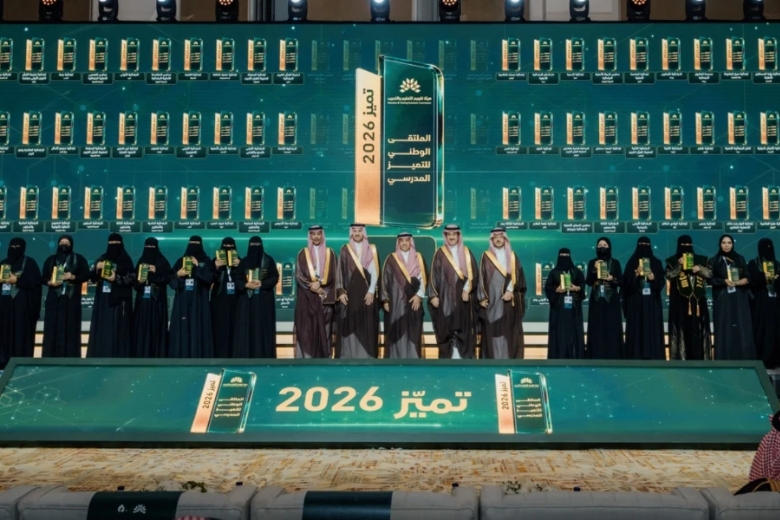
Saudi Arabia has recognised 659 schools for educational excellence, highlighting progress in school quality and learning standards across the Kingdom.
The recognition, awarded through the National Programme for School Evaluation, Classification and Accreditation, includes public, private and international schools. It also offers parents and educators a wider picture of how schools are assessed and encouraged to improve.
The awards were presented during the third National Forum for School Excellence, Tamayuz 2026, in Riyadh. The event brought together education officials to recognise schools that achieved the programme’s excellence level.
Saudi Schools Show Progress in National Evaluation Programme
The Education and Training Evaluation Commission (ETEC) honoured the schools at the forum’s conclusion. Minister of Education Yousef Al-Benyan and ETEC Chairman Khalid bin Abdullah Al-Sabti recognised their achievements.
According to the Saudi Press Agency, the number of schools reaching the excellence and progress levels has risen to around 14,000 in recent years.
Al-Benyan said the increase reflected significant improvements in the Kingdom’s education system. He also highlighted the efforts of schools working to raise educational standards and improve learning outcomes.
For parents, these evaluations can provide useful insight into school performance. For school leaders and teachers, they offer a framework for identifying strengths and areas that need further development.
How Saudi Arabia Evaluates School Performance
The National Programme for School Evaluation, Classification and Accreditation aims to improve the quality of education and training. It uses performance data and indicators to monitor school standards.
The programme combines self-evaluation with external assessment. This approach encourages school leaders to review their practices while also providing an independent picture of school performance.
Since 2024, more than 27,000 school principals have received online training in self-evaluation. In addition, over 2,500 school evaluation specialists have taken part in the process.
Assessment activity has also reached classrooms and wider school communities. Specialists have visited more than 2,200 locations and recorded over 1.3 million classroom observations.
They have also conducted more than one million interviews with students and staff. Furthermore, the evaluation process includes 235,000 observations of school environments and analysis of over 230,000 school documents.
What School Evaluation Means for Parents and Educators
The recognition highlights the importance of looking beyond academic results when assessing school quality. Classroom practice, the learning environment and the experiences of students and staff also contribute to the evaluation process.
For parents choosing a school, evaluation outcomes can be one useful source of information. However, families should also consider their child’s needs, the curriculum, pastoral care and the school’s wider learning environment.
Meanwhile, school leaders can use evaluation findings to guide improvement plans and strengthen teaching practices. Teachers can also benefit when assessment identifies areas for professional development and better classroom support.
The rise to around 14,000 schools at the excellence and progress levels suggests that the programme is reaching a growing number of institutions. Ultimately, its value will depend on how consistently schools use the findings to improve learning experiences and outcomes for students.
A Wider Role for Parents in School Evaluation
The programme also seeks to include the views of the wider school community. More than 10.5 million questionnaires have been distributed among students, teachers and families.
This gives evaluators a broader understanding of school conditions and the needs of different stakeholders. It also means that school improvement can draw on feedback from the people who experience education every day. Saudi Press Agency+1
The Ministry of Education describes school evaluation as an ongoing process. It identifies strengths, areas for improvement and the effectiveness of schools’ development efforts. Ministry of Education
For Saudi schools, the challenge now is to turn evaluation findings into sustained improvements. These should be reflected in teaching quality, student progress and the everyday experience of learners.
For more details please visit
Further Reading
- What Makes A School Feel Like The Right Place For Your Child?
- King’s College Riyadh Brings British Education And Holistic Learning To Its New Sedra Campus